
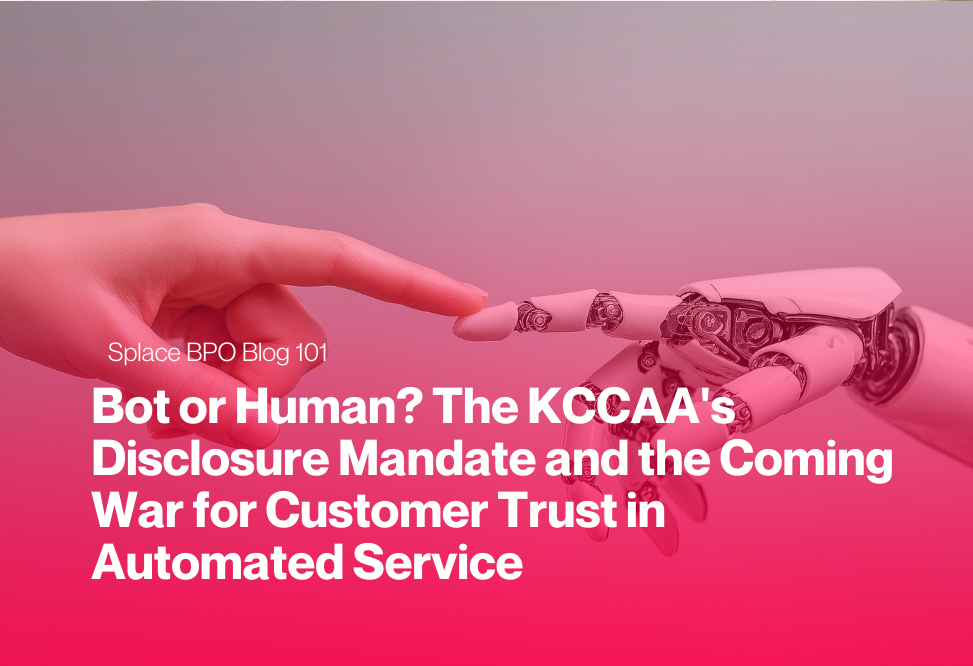
As automation continues to transform the customer service industry, a new challenge has emerged: the need for full transparency about the use of artificial intelligence (AI) and bots in customer interactions. The KCCAA’s Disclosure Mandate is pushing companies to be upfront about whether customers are speaking to a bot or a human agent. While this move aims to protect consumers, it also raises concerns about the long-term effects on customer trust and brand perception.
In this blog, we explore how mandatory disclosure will reshape the future of customer service and what it means for businesses navigating the fine line between AI efficiency and human empathy.
The KCCAA Disclosure Mandate: What’s Changing?
The KCCAA (Korea Consumer Protection Agency) has recently introduced a mandate requiring businesses to disclose when customers are interacting with AI-powered bots instead of human agents. This move is intended to provide greater transparency, ensuring that customers are aware when they’re communicating with an automated system rather than a real person. However, this regulatory change comes with both benefits and challenges for businesses.
While disclosure may seem like a step toward more ethical consumer practices, it also brings significant risks to brands that rely heavily on automation in customer service.
The Impact on Customer Behavior
The key question now is: How will mandatory disclosure affect consumer behavior? On one hand, some customers may appreciate the honesty, while others could feel misled or frustrated when they realize they are interacting with a bot. Here's how this could play out:
- Increased Transparency:
For some consumers, knowing that they’re speaking with an AI system might make them feel more comfortable, especially if the bot is well-programmed to provide quick and efficient responses. Transparency could lead to greater trust, as customers are no longer kept in the dark about the nature of the interaction. - Decreased Trust and Satisfaction:
On the other hand, many consumers expect human interaction when it comes to customer service, especially for complex issues. If they know they’re talking to a bot, they may feel that the brand doesn’t value their concerns. This can lead to a sense of disconnect and dissatisfaction, especially if the AI is unable to handle more nuanced queries.
Shift in Brand Perception:
Disclosure could drastically shift how customers perceive a brand. If a business is open about using bots or offshore agents, it could be seen as forward-thinking and transparent. However, if customers feel that bots compromise the quality of service or that offshore agents are not equipped to provide the necessary assistance, it could harm a brand’s reputation.
The War for Customer Trust: AI vs. Human
One of the biggest challenges in the coming years will be the battle for customer trust in automated services. On the one side, brands that use bots and AI can deliver faster, more efficient service at a lower cost. On the other side, human agents can offer the personal touch, empathy, and complex problem-solving that automated systems still struggle with.
AI and Bots: The Efficiency Advantage
- Cost-Effective: Bots and AI systems can handle hundreds or even thousands of customer queries simultaneously, reducing the need for a large human workforce. This can lower operational costs and improve efficiency.
- 24/7 Availability: Unlike human agents, AI-powered bots can operate around the clock, providing immediate responses to customer inquiries at any time of day.
Data-Driven Responses: Bots can access vast amounts of data to provide quick, accurate answers, making them ideal for routine questions and simple tasks.
Humans: The Empathy Advantage
- Emotional Intelligence: Humans can read emotional cues and adapt their responses, offering customers a sense of connection and understanding that bots cannot replicate.
- Complex Problem Solving: When issues are too complex for bots, customers rely on human agents who can think critically, make nuanced decisions, and handle difficult situations with care.
Customer Loyalty: Customers who feel heard and valued by human agents are more likely to remain loyal to a brand, trusting that their needs will be met.
Conclusion:
The KCCAA’s disclosure mandate marks a turning point in automated customer service, where transparency becomes a competitive advantage rather than a compliance burden. As customers grow more aware of when they’re interacting with bots versus humans, trust will hinge on honesty, seamless escalation, and service quality. Companies that balance automation with clear disclosure and human oversight will be best positioned to win in this new era of customer experience.
FAQS
1. What is the KCCAA’s disclosure mandate?
It requires companies to clearly inform customers when they are interacting with an automated system instead of a human agent.
2. Why does this mandate matter for customer trust?
Transparency helps prevent confusion or frustration, reinforcing trust by setting clear expectations about the service experience.
3. How can companies comply without hurting customer experience?
By combining upfront disclosure with smooth handoffs to human agents and well-designed AI systems that enhance—rather than replace—support quality.
About Splace BPO
Splace BPO empowers brands by providing offshore professionals who are not only highly skilled but also trained to excel in an AI-driven business landscape. By combining human expertise with future-ready capabilities, we help businesses scale smarter, adapt faster, and stay competitive in a rapidly evolving market.
📧 info@splacebpo.com
🌐 www.splacebpo.com