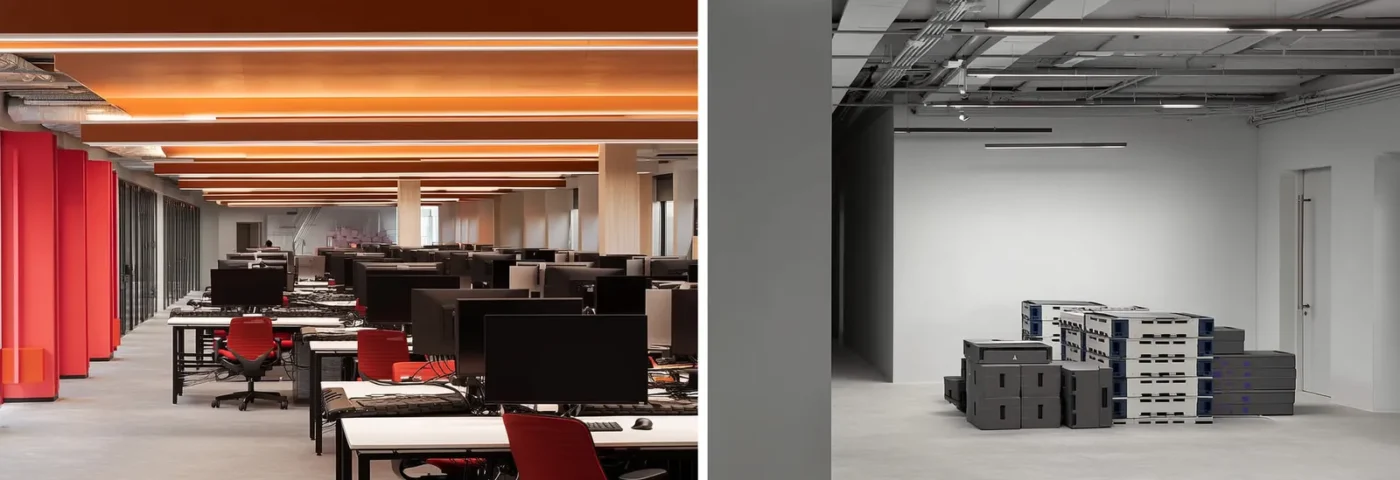
When you're ready to hire 10–30 people in the Philippines, the infrastructure decision arrives fast. Do you sign a commercial lease, fit out an office, and build the operation from scratch? Or do you lease ready-made seats inside a managed facility and start work immediately? The seat leasing vs traditional office Philippines debate isn't academic — it directly affects your cash position, your timeline, and your ability to scale. This article breaks down the real cost difference so you can make a clear-eyed decision.
What Each Setup Actually Involves
A traditional office setup in the Philippine context means signing a commercial lease, sourcing and fitting out furniture, procuring and configuring IT hardware, establishing network infrastructure — ISP contracts, firewalls, structured cabling — and arranging ongoing facility management. You own the environment, which means you own every variable inside it.
Seat leasing works differently. A provider supplies a fully equipped, network-ready workstation inside a managed facility. The client pays a per-seat monthly fee and arrives operational. The infrastructure is already in place.
Both options can support the same headcount. The inputs, timelines, and cost structures are fundamentally different.
The Traditional Office: Where the Costs Stack Up
The cost categories for a traditional office build are predictable in type, but often underestimated in scale. City matters here: commercial lease rates in Metro Manila differ meaningfully from those in Davao City, and that gap flows through every line item below.
Capital Expenditure: The Upfront Hit
Before a single employee starts work, a traditional office setup requires a significant cash outlay:
- Lease deposits. Commercial leases in the Philippines typically require two to three months' advance rent plus two to three months' security deposit. That's up to six months of rent committed before operations begin.
- Fit-out costs. Partitions, flooring, lighting, and ergonomic furniture for BPO-grade space carry real per-square-meter costs. These vary by city, contractor, and specification — a sourced current market range is noted as a knowledge gap below, but even conservative estimates make fit-out a material line item at 20–30 seats.
- IT hardware procurement. Workstations, monitors, headsets, and UPS units multiply quickly across a 20-person team. Per-seat hardware costs are not trivial, and procurement lead times add to the setup delay.
- Network infrastructure. Structured cabling, switches, routers, firewall appliances, ISP installation fees, and redundant line setup are one-time costs that nonetheless require both capital and technical expertise to execute correctly.
These are one-time expenditures, but they depreciate — creating an ongoing accounting burden that sits on the balance sheet for the life of the equipment.
Ongoing Operational Costs
- Monthly commercial rent, priced per square meter, with BPO-grade space in Philippine CBDs commanding a premium over general commercial space.
- Utilities: electricity and water. BPO operations frequently run extended hours, making power costs a significant monthly variable.
- IT maintenance contracts and hardware refresh cycles — workstations don't last indefinitely.
- Facility management: security personnel, janitorial services, building administration fees.
- IT and network staff, or a managed service provider retainer to keep the infrastructure running.
These costs are fixed regardless of seat occupancy. A team that scales unevenly — common during growth phases — pays for empty desks every month.
Hidden Costs That Rarely Appear in the Initial Budget
- Compliance documentation. DOLE workplace standards, fire safety certificates, and building permits require time and professional fees that rarely make it into the first-pass budget.
- Setup downtime. Every week the office isn't ready is a week hiring is delayed. Delayed hiring means delayed output.
- Management bandwidth. Someone internal has to own the build-out project. That person is pulled away from their actual job for weeks or months.
- Over-provisioning. Companies routinely lease more space than they immediately need to allow for growth. From day one, they pay for seats that are empty.
Seat Leasing: What You Actually Pay For
Seat leasing converts capital expenditure into a predictable operating expense. The per-seat monthly fee covers the workstation, chair, monitor, network access, power, air conditioning, security, and facility management — bundled into a single line item. There is no fit-out cost, no hardware procurement process, and no ISP negotiation.
Splace operates Secure Seat Leasing and Infrastructure Hubs in Davao City. The workspace is compliance-documented and network-segmented. Splace holds CCAP accreditation, which provides an independent credibility signal for clients in regulated industries. ISO 27001 certification is currently in progress — it has not yet been achieved, and we won't claim otherwise.
Specific per-seat monthly pricing is noted as a knowledge gap below — contact Splace directly for current rates.
Time-to-Operational: A Cost in Itself
A traditional office setup in the Philippines realistically takes 60 to 120 days from lease signing to operational readiness, accounting for fit-out, IT configuration, and permit acquisition. That estimate reflects general industry experience; city-specific timelines can vary.
Seat leasing can have a team operational in days, not months.
The opportunity cost of that gap is real. Delayed hiring means delayed customer service capacity, delayed finance operations output, delayed sales support coverage. For a company under pressure to staff a CX or finance ops team quickly, two to four months of setup time is not an abstract inconvenience — it has a direct impact on what the business can deliver.
Scalability: How Each Model Handles Headcount Changes
Scaling a traditional office up means renegotiating or expanding the lease, procuring additional hardware, and potentially re-cabling — slow and capital-intensive. Scaling down means paying for unused space until the lease term ends.
With seat leasing, adding or removing seats is a contractual adjustment, not a construction project.
For companies in the 10–150 headcount range, this flexibility is operationally significant. Splace's Ops Pods — pre-configured teams of 5 to 15 FTE — can be deployed in approximately 30 days, and they pair directly with seat leasing infrastructure. The team and the workspace scale together.
When a Traditional Office Setup Makes Sense
This section deserves genuine weight. Seat leasing is not the right answer for every situation.
A traditional office setup may make sense when:
- Headcount is large and stable — 200 or more employees — where per-seat lease economics begin to shift in favor of an owned, amortized fit-out.
- The operation requires highly customized physical infrastructure: specialized hardware labs, unusual power configurations, or proprietary network architecture that a shared facility cannot accommodate.
- The company has a confirmed long-term Philippine presence — five years or more — with capital allocated specifically for physical infrastructure investment.
For large, stable, long-horizon operations, the cumulative per-seat lease cost can eventually exceed the fully amortized cost of an owned fit-out. That crossover point exists. The key word is eventually — and most growing teams don't have the runway, the headcount stability, or the capital certainty to plan around it.
The Practical Decision Framework
Choose seat leasing if:
- Your headcount is under 150.
- You need to be operational in under 90 days.
- Capital preservation is a priority.
- You are still validating the Philippine operation and want to avoid locking capital into infrastructure.
Consider a traditional office if:
- Your headcount is large and stable.
- You have a five-plus year commitment to the Philippines.
- You have capital allocated for fit-out and the internal capacity to manage the build.
Why Location Within the Philippines Matters
Seat leasing costs and traditional office costs both vary significantly by city. Davao City offers lower commercial real estate costs than Metro Manila, a large English-proficient talent pool, and growing BPO infrastructure. For companies building a Philippine operation for the first time, that cost differential flows through every line item in the comparison above.
Splace is headquartered in Davao City. That is a deliberate infrastructure choice — not just a location fact. Lower real estate costs in Davao translate directly into more competitive seat leasing rates, and the city's talent base supports the CX, finance ops, and sales support functions that most of Splace's clients are building.
Specific cost-per-square-meter comparisons between Davao City and Metro Manila are noted as a knowledge gap below — verified figures would strengthen this section.
Next Step: Get a Clear Picture of Your Setup Costs
Seat leasing eliminates the capital expenditure, compliance burden, and setup delay that come with a traditional office — giving growing teams a faster path to operational readiness in the Philippines.
If you're mapping out a 10–150 person Philippine operation and want a concrete picture of what your setup actually costs under each model, book a 20-minute Ops Audit with Splace. It's a working session: your headcount, your timeline, your infrastructure requirements. No pitch, no pressure.