A 20-person Philippine CX team. Fully remote. Six months in, the cracks appear: agents miss shift handoffs because a Slack message got buried, a security incident triggers a client escalation, attendance records don't match logged hours, and onboarding a new hire takes three weeks instead of one. None of these problems are catastrophic on their own. Together, they compound into an operational drag that shows up in SLA breaches and rising management hours — not on any single invoice line.
This is the core tension in the seat leasing vs. remote work Philippines BPO debate. Remote-first is not inherently wrong. For small, established teams it is often the right call. But remote work is not always the lower-cost or lower-risk option, and there are specific operational thresholds where a managed physical hub becomes the rational default — not a luxury. Splace BPO was built around exactly this problem: providing Philippine teams with a single, accountable infrastructure that removes the operational drag before it compounds.
This post maps those thresholds using the Splace model as the reference point. The goal is to give ops leaders a clear decision framework grounded in how Splace actually structures its hubs and managed teams.
Why Remote-First Became the Default for Philippine BPO Teams
The appeal is legitimate. No facility deposit. Faster access to talent across provinces. Lower perceived overhead on day one. Post-pandemic, distributed work became normalized across the Philippine outsourcing market, and many early-stage offshore teams were built on that assumption.
The problem is scale. What works at three to five FTE often starts breaking at fifteen to fifty FTE — and the breakage is rarely visible until it is already expensive. Coordination costs accumulate quietly. Compliance exposure builds in the background. By the time the issues surface, they are harder and costlier to fix than if the infrastructure had been right-sized from the start. Splace's Ops Pods model — pre-configured managed teams of 5–15 FTE deployed in approximately 30 days — is designed specifically to address this gap before it becomes a crisis.
The Four Thresholds Where Remote Setups Start to Break Down
These are not arguments against remote work. They are decision triggers — specific conditions where the operational math shifts in favor of a managed hub. Splace's infrastructure and service model maps directly to each one.
Threshold 1: Team Size Crosses 10–15 FTE
Below ten FTE, async coordination and chat-based management are workable. Above ten to fifteen FTE, the complexity compounds. Shift handoffs require documented escalation chains. QA monitoring needs a supervisory layer. HR issues — attendance disputes, performance coaching, conflict resolution — require real-time visibility that is difficult to enforce across a distributed home setup.
Physical co-location does not eliminate management overhead, but it reduces the friction at every point in the chain. A supervisor on the floor can intervene in the moment. Remotely, the same intervention requires scheduling, documentation, and follow-up — multiplied across every agent on the team. Splace's Ops Pods are pre-configured for this range: 5–15 FTE teams with built-in supervisory structure, deployed from Splace's Davao City hubs, ready in approximately 30 days.
Threshold 2: Data Handling and Compliance Requirements Tighten
Remote agents processing personally identifiable information, payment data, or health records from personal home networks create real audit exposure. The Philippine Data Privacy Act (Republic Act 10173) requires organizations to implement documented technical and organizational controls over personal data handling. Enforcing those controls across twenty individual home setups — each with its own router, device, and network environment — is materially harder than enforcing them in a single, controlled facility.
For FinTech and HealthTech clients in particular, enterprise vendor due diligence increasingly requires documented physical security controls. A failed client audit or a data incident does not show up as a line item until it is already a crisis — and the remediation cost typically exceeds twelve months of seat leasing fees.
Splace's Davao infrastructure hubs are compliance-documented and network-segmented environments designed to address exactly this exposure. Splace holds CCAP accreditation. ISO 27001 certification is currently in progress — it has not yet been achieved, and any vendor claiming otherwise should be pressed for documentation. For clients in regulated industries, Splace's hub model provides the documented physical controls that a distributed home-agent setup structurally cannot.
Threshold 3: IT Security and Equipment Standardization Become Unmanageable
At small scale, remote IT management is inconvenient. At scale, it becomes a dedicated operational burden. Companies either ship and manage company-owned devices — which creates capital expenditure, logistics complexity, and asset tracking overhead — or they accept BYOD risk, which introduces endpoint vulnerabilities that are difficult to audit and nearly impossible to remediate uniformly.
A managed hub shifts that burden to the facility operator. Standardized hardware, controlled network access, and centralized endpoint management are built into the infrastructure rather than bolted on after the fact. Splace's infrastructure hubs provide network-segmented workspaces as part of the seat leasing offering — specific technical specifications are noted in the knowledge gaps below, as those details require internal confirmation before publication.
Threshold 4: Supervision, Culture, and Performance Accountability Degrade
Remote-first works when a team's culture is already established. Building that culture from scratch across a geographically distributed team is slow, and the foundations are fragile. New hires in particular benefit from in-person onboarding: faster ramp time, clearer behavioral norms, and peer learning that happens naturally in a shared environment.
Performance management — coaching, performance improvement plans, terminations — is also cleaner when supervisors have documented, real-time visibility. Physical presence addresses a cost that most ops leaders know exists but rarely discuss openly: time theft and attendance fraud. At scale, these are real operational costs, not hypothetical ones. Splace's on-site supervisory model, embedded within each Ops Pod, is structured to maintain this visibility as a standard operating condition rather than an exception.
The Hidden Costs of Remote That Don't Show Up on the First Invoice
Remote setups look lean on day one. The costs that accumulate over time are distributed across departments and rarely attributed to the remote model itself. They include:
- IT support overhead — troubleshooting home network issues, device failures, and security incidents across a dispersed team
- Device procurement and logistics — purchasing, shipping, tracking, and recovering company-owned equipment
- Compliance audit remediation — the cost of retrofitting controls after a client or regulator flags a gap
- Turnover from isolation — attrition driven by disengagement, which carries replacement and retraining costs
- Management time lost to async delays — hours spent chasing responses, re-explaining context, and re-doing work that would have been caught in real time
- Rework from miscommunication — errors that compound when there is no shared environment to catch them early
None of these appear as a single line item. All of them erode margin over time. Splace's bundled model — Ops Pods, EOR, and secure seat leasing under one SLA and one invoice — is structured to make these costs visible and manageable from the start, rather than discoverable after the fact.
What a Managed Physical Hub Actually Provides (Beyond a Desk)
Seat leasing is often framed as office space. That framing undersells what a properly managed hub actually delivers.
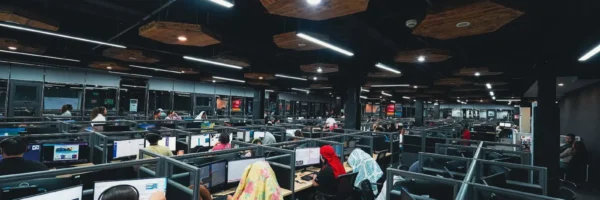
A compliance-documented, network-segmented facility is operational infrastructure. It provides a controlled environment for data handling, standardized equipment, on-site supervisory support, and a single accountable vendor relationship. When something goes wrong — a network issue, a compliance question, an HR escalation — there is one point of contact, one SLA, and one party responsible for resolution.
This is the structure Splace operates under. Splace's infrastructure hubs in Davao City are CCAP-accredited facilities built for BPO and offshore team operations. The EOR layer means Splace also serves as the legal Philippine employer — onboarding in as little as 72 hours, at approximately $249 per employee per month. ISO 27001 certification is in progress. Specific hub amenities, seat capacity, and redundancy specifications are noted in the knowledge gaps below pending internal confirmation.
How to Decide: A Simple Decision Framework
Apply these four questions to your current Philippine team setup:
- Is your team at or approaching 10 FTE or more in the Philippines?
- Do your agents handle regulated data — PII, payment information, or health records?
- Are you experiencing measurable QA failures or attendance issues you have not been able to resolve remotely?
- Has a client, auditor, or internal security review flagged your remote setup as a compliance risk?
If you answered yes to two or more of these, a managed hub is worth a direct cost comparison against your current remote setup. The comparison should include the hidden cost categories above — not just the visible facility line item. Splace's Ops Audit is designed for exactly this: a structured review of your current setup against the actual risk and cost of staying remote, without a sales process attached.
Why Davao, and Why It Changes the Cost Equation
Davao City has developed a credible BPO infrastructure over the past decade. Labor costs sit below Metro Manila rates, and the talent pipeline — particularly for CX, finance operations, and sales support roles — is established and growing. Infrastructure stability has improved alongside the city's broader economic development.
Splace is headquartered in Davao City specifically to pass that cost advantage to clients. Physical infrastructure without Metro Manila cost premiums, combined with the compliance and supervision standards that enterprise clients require, is the operating premise behind Splace's hub model. For companies comparing hub options, Davao is not a compromise — it is a deliberate cost and quality decision.
Conclusion
Remote-first is a reasonable default for Philippine offshore teams. It has real advantages, and it works well within certain parameters. But it has operational limits — and those limits are predictable. Team size, data handling requirements, IT complexity, and supervision needs each create a threshold where the cost and risk of staying remote exceeds the cost of a managed hub.
Splace BPO is built around those thresholds. CCAP-accredited hubs in Davao City. Managed Ops Pods of 5–15 FTE deployed in approximately 30 days. EOR coverage as the legal Philippine employer in as little as 72 hours. One SLA, one invoice, one accountable relationship.
Knowing where your team sits against these thresholds lets you make a deliberate, cost-informed decision rather than discovering the limits after they have already created problems.
If your team is approaching one of these thresholds, an Ops Audit with Splace maps your current setup against the actual risk and cost of staying remote. It is a 20-minute conversation, not a sales process. Book a session at splacebpo.com.